Inside HbbTV DRM: Standards, market insights and real-world deployments
As broadcasters and content providers expand into connected and hybrid TV environments, the need for robust, standardised Digital Rights Management (DRM) has become critical. Ensuring that premium content is securely delivered while maintaining interoperability across a fragmented device landscape is central to sustaining the trust of content owners and viewers alike.
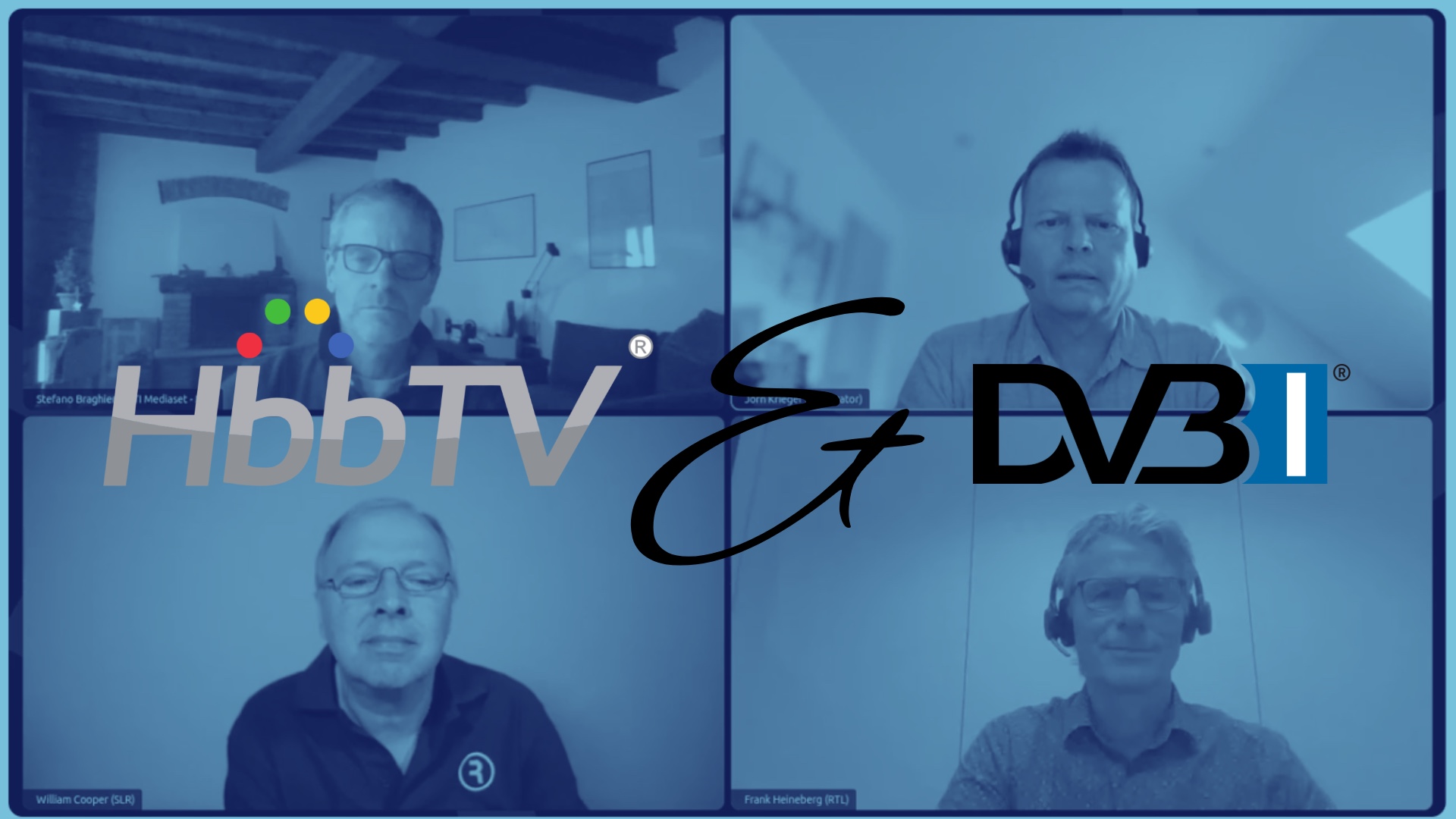
The HbbTV Association dedicated its latest webinar on 29 October 2025 to exploring the evolving DRM landscape in HbbTV, featuring perspectives from leading figures in specification development, content protection, and real-world deployment. The session was moderated by journalist Jörn Krieger, with contributions from Jon Piesing (HbbTV Association / TP Vision), Thierry Thévoz (Nagravision), Fabio Guarnaccia (Mediaset), and Juha Joki (Sofia Digital).
Access the full recording and download the presentations from the HbbTV website.
HbbTV DRM guidelines and standardisation
Opening the webinar, Jon Piesing, Vice-Chairman of the HbbTV Association and Chair of its Specification Group, traced the evolution of DRM within HbbTV from early proprietary integrations to today’s open, standardised framework.
“Access to DRM-protected content has become fundamental for HbbTV content providers,” he explained. “As services move from HD to UHD, content owners demand increasingly strict protection levels, and TV manufacturers must support these capabilities to remain compatible.”
Early HbbTV deployments often treated DRM as an external, proprietary element, with country-specific implementations. This fragmentation discouraged service development. Recognising this, the HbbTV Association funded the creation of a DASH-DRM Reference Application in 2017, allowing developers and manufacturers to test interoperability across devices.
Recent advances have formalised this work. The HbbTV DRM Integration Specification, published in 2024, now defines a consistent framework and associated tests. It covers both Microsoft PlayReady and Google Widevine, with plans to extend testing in upcoming versions of the HbbTV Test Suite.
“The specification provides an open, tested definition of how to integrate HbbTV and DRM,” said Piesing, noting that while HbbTV does not mandate a particular system, the majority of deployed TVs already support one or both major DRMs. Around 97 % of new sets support PlayReady, 85 % PlayReady SL3000 hardware protection, and 60–65 % Widevine.
DRM from the conditional access and security provider perspective
Thierry Thévoz, Principal Software Architect at Nagravision, explored DRM from a security provider’s standpoint, outlining the fundamental role of content protection in enabling commercial and premium business models.
“DRM is directly tied to content value,” he said. “Free-to-air content may not require encryption, but once you deliver premium sports or 4K movies, content owners insist on DRM protection to ensure playback only on legitimate, certified devices.”
Thévoz explained the distinction between software DRM, suitable for SD and HD content, and hardware-based DRM such as PlayReady 3000 or Widevine Level 1, which meet MovieLabs’ Enhanced Content Protection (ECP) requirements for 4K and UHD material.
He emphasised that successful deployment requires not only secure servers and encryption workflows, but also verification that each HbbTV browser correctly implements the chosen DRM. Device variability remains a challenge, making testing essential to ensure smooth playback and proper licence handling across models.
Drawing on a real-world example, Thévoz described Nagravision’s support for the FIFA World Cup 2022, where a multi-DRM system secured 4K OTT delivery using PlayReady 3000 within an HbbTV hybrid service. Nagravision’s DRM platform now underpins HbbTV’s own validation framework, testing DRM implementations during certification.
“The key,” he concluded, “is to combine robust delivery, validated hardware, and real-world testing to guarantee a seamless user experience.”
The Italian perspective: Implementing DRM in broadcaster environments
Turning to the broadcaster view, Fabio Guarnaccia, Scenario Analysis Manager at Mediaset, explained why DRM is now integral to every major content-licensing agreement.
“In the digital environment, it’s easier than ever to copy and share content illegally,” he said. “At the same time, new business models, particularly freemium offerings, depend on DRM to balance free and paid access securely.”
Guarnaccia outlined how contracts with international studios typically require that all internet-delivered content be encrypted under an approved DRM system, with strict control over device authorisation. Licences must be linked cryptographically to each certified device, preventing re-use or redistribution.
From a compliance standpoint, broadcasters must verify that devices maintain content integrity, exclude insecure software implementations, and meet defined protection levels before allowing playback.
“Managing content protection across devices is essential,” Guarnaccia said. “We need to identify each device, check its DRM compliance, and block delivery if requirements are not met, otherwise, we risk breaching our agreements with rights-holders.”
For Mediaset, which operates both free-to-air and OTT services such as Infinity Plus, consistent DRM management across all distribution models is crucial to maintaining trust with content partners and audiences alike.
Market Reality: Insights from the DASH-DRM reference application
Concluding the presentations, Juha Joki, Technical Director at Sofia Digital, provided an update on the DASH-DRM Reference Application, an open-source testing platform funded by HbbTV. The application, first released in 2017, has become a vital interoperability tool for manufacturers, app developers, and even browser vendors.
“Everything is open-source and MIT-licensed,” Joki noted. “Anyone can run it to test DRM playback on their devices and gain practical experience with PlayReady, Widevine, or ClearKey.”
Over 100 TV models, representing all generations of HbbTV receivers, have now been tested using the app. It supports multiple playback modes, including native players and HTML5 MSE/EME environments, and is continuously updated in line with the HbbTV Test Suite.
The tool is not for certification, but to provide real-world feedback from receivers, helping identify inconsistencies in playback, licence persistence, subtitle handling, and performance across resolutions. Monthly anonymised test reports are shared with the HbbTV Association to inform future specification work.
“The goal,” said Joki, “is to provide transparent insight into how DRM performs across the real market. The statistics show steady improvement, but there’s still work to do, especially as new devices and features arrive.”
Key takeaways and future directions
The panel’s Q&A highlighted several recurring themes:
- Interoperability and testing are vital: developers must verify both legacy and new devices, as the installed base spans over a decade of TV models.
- Hybrid protection models will persist: conditional access (CA) remains dominant for broadcast, while DRM governs OTT and hybrid content.
- Standardised APIs (OIPF DRM Agent and EME) offer flexibility, though developers must balance reach against capability.
- Hardware DRM is essential for UHD and premium rights, aligning with international content-security mandates.
As moderator Jörn Krieger summarised, DRM in HbbTV represents “an evolving standard that continually adapts to the market’s needs, ensuring content protection and enabling new monetisation models.”
Looking ahead: From DRM to monetisation
The discussion also served as a prelude to the HbbTV Symposium and Awards 2025, taking place on 12–13 November in Istanbul, co-hosted with TV Ekstra. This year’s theme “Making Money with HbbTV” connects naturally to the DRM debate, as secure, standardised content delivery underpins advanced business models such as addressable advertising and premium streaming.
With the publication of the HbbTV DRM Integration Specification, the ecosystem now has a common foundation to build upon. As more broadcasters and device makers adopt it, the industry moves closer to a unified, secure, and commercially viable connected-TV environment.
Access the full recording of the webinar and download the presentations from the HbbTV website.