
The role of HbbTV in an IP-only future
This article is part of a series based on presentations from the HbbTV Symposium and Awards 2025, bringing together insights from across the industry on the future of broadcast services and connected television. Covering topics from broadband-only delivery and addressable advertising to interoperability and evolving standards, the series captures key discussions and expert perspectives shaping the next phase of HbbTV and the wider TV ecosystem.
The role of HbbTV in an IP only future roundtable
As broadcasters and platform operators increasingly look towards IP delivery, one question is becoming more important: what role will HbbTV play when television is no longer distributed primarily through traditional broadcast networks?
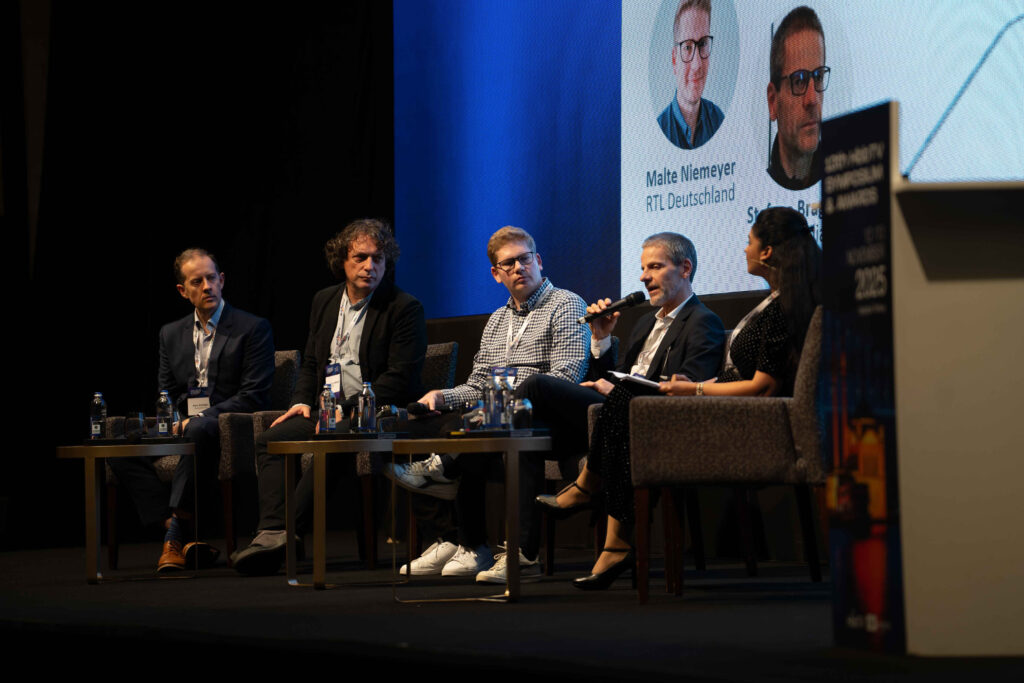
This was the focus of a roundtable discussion at the HbbTV Symposium 2025, moderated by Ranjeet Kaur, Programme Director at the DTG. Joining her were Alex Russell, Controller of Technical Partnerships at Everyone TV, Bram Tullemans, Senior Expert Technology & Innovation at the European Broadcasting Union (EBU), Malte Niemeyer from Distribution Engineering at RTL Deutschland, and Stefano Braghieri from Mediaset’s Innovation and Technical Research Department. Together, they explored how HbbTV can evolve to support an increasingly IP-centric television landscape.
The discussion was framed by wider industry developments. Across Europe, broadcasters, regulators and technology providers are actively examining how television distribution will evolve over the coming decade. In the UK, for example, the government-backed Future of TV Distribution project is evaluating different scenarios ranging from continued investment in terrestrial broadcasting through to eventual migration towards IP-based delivery. Similar conversations are taking place in other markets.
Despite differing national approaches, the panel agreed that IP delivery will continue to grow. The question is not whether IP will become more important, but how the industry can manage the transition while maintaining the reliability, accessibility and interoperability that viewers expect from television.
For Stefano Braghieri, who has been closely involved in Italy’s DVB-I commercial trial, HbbTV remains a critical component of this future. He argued that DVB-I provides a practical mechanism for transitioning viewers from broadcast to IP without fundamentally changing how they access television. At the same time, HbbTV enables advanced services that cannot easily be delivered through native device interfaces alone, including addressable advertising and enhanced interactive experiences.
Braghieri also noted that many broadcasters are already relying on HbbTV applications to control media presentation and deliver services. In an IP-only environment, these capabilities become even more important, strengthening rather than reducing the relevance of HbbTV.
Malte Niemeyer highlighted a similar perspective from Germany. While linear broadcast television remains important, RTL sees value in maintaining the openness and interoperability that HbbTV provides. The standard gives broadcasters control over their services, data and user experience across a fragmented device ecosystem. As television distribution increasingly moves towards IP, preserving these advantages remains a priority.
One area of focus for RTL is the performance of IP-delivered services. Niemeyer suggested that future work may include additional guidance or requirements around areas such as application startup times and stream acquisition, ensuring that IP-delivered television can match viewer expectations established by traditional broadcast services.
The UK experience provided perhaps the clearest indication that IP-only viewing is already becoming a reality for some audiences. Alex Russell described how the Freely platform, which is built on HbbTV technology, has seen a significant proportion of users connect their televisions directly to broadband without connecting an aerial. This demonstrates that for many viewers, particularly younger households, television is already becoming an IP-first experience.
Freely is also preparing for the emergence of dedicated IP-only devices, extending beyond connected televisions to include additional device formats. According to Russell, one of the key challenges is ensuring robust testing and conformance processes so that services behave consistently across a growing range of devices and platforms.
The panel also discussed what HbbTV itself may need to become in an IP-only world. Bram Tullemans outlined the objectives of the newly announced HbbTV Study Mission Group (SMG) on all-IP delivery. While the group’s conclusions have yet to be determined, its purpose is to explore how HbbTV can continue to provide interoperability between content providers and device manufacturers as television evolves.
A recurring theme was whether an IP-only profile of HbbTV might be required. Several panellists suggested that there is value in defining a clearer subset of functionality specifically for IP-only devices, removing requirements that are only relevant to broadcast reception. At the same time, there was broad agreement that any future evolution should remain closely aligned with the core specification rather than creating entirely separate standards.
The discussion also challenged the assumption that IP-only television automatically means IP-only devices. As several participants noted, television manufacturers are likely to continue shipping devices with tuners for many years, even in markets where IP viewing becomes dominant. Hybrid environments will therefore remain important for the foreseeable future.
The roundtable concluded with a strong consensus that HbbTV has an important role to play in the next phase of television evolution. Whether services are delivered via broadcast, broadband or a combination of both, the need for interoperability, testing, accessibility and consistent user experiences remains unchanged.
As the industry moves towards an increasingly IP-driven future, HbbTV is well positioned to provide the common framework that connects broadcasters, device manufacturers and viewers. Rather than becoming less relevant, the panel suggested that HbbTV may become even more important as television distribution continues its transformation.
Watch the presentation and explore further
You can watch the full presentation from the HbbTV Symposium 2025 here: Watch the Video
The presentation slides are also available to download: Download the presentation
Next in the series
Learn how broadcasters across the MENA region are using HbbTV to increase audience engagement and unlock new revenue streams. Atila Madakbaş from Admongrel explores how analytics, AI and advanced advertising tools are helping broadcasters better understand their